|
|
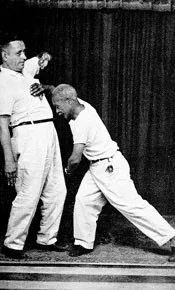
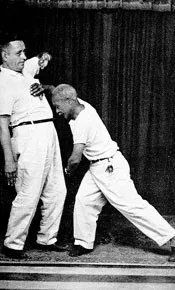
| Demonstrating knowledge of body leverage, Master Pastinha prepares to throw his opponent off balance. |
Black Belt Magazine: CAPOEIRA, BRAZILIANS KARATE
by Master Pastinha
The Players would jump, weave, gambol, trip, and kick their opponents, then avoid retaliation by slithering on the ground like serpents.
Some 400 years ago in Angola, on the west coast of Africa, a form of combat practiced by the natives was beginning to take shape in what we would today call a martial art. Four centuries later, thanks to a mutual tie with Portugal which Angola shares with Brazil, Capoeira is practiced in that South American nation. It is no longer the savage method of self-defense which originated in the dark continent, however. And thereby hangs a tale. In the days of the great plantations, the owners took a dim view of the capability for mayhem which the natives possessed. Practitioners of Capoeira suffered great persecution at the hands of the owner-dominated police. In order to avoid this persecution, the Capoeristas began to camouflage their "sport" by turning it into a weird dance, consisting of pantomime, music, and dances. Capoeira ceased to be a matter of violence and death, and became an amusement. It became the custom to remark that "the natives are playing Angola style." Even the plantation foremen would applaud the "performances" as the "players" would jump, weave, gambol, trip, and kick their opponents, then avoid retaliation by slithering on the ground like serpents. So in spite of early difficulties, Capoeira caught on. Legendary names appeared—invincible fighters, men with flesh impenetrable by knife or bullet; men under contract to the devil; men with charms against the most powerful of enemies; men who could liberate themselves from any kind of a trap.
INSTRUMENTS OF CAPOEIRA
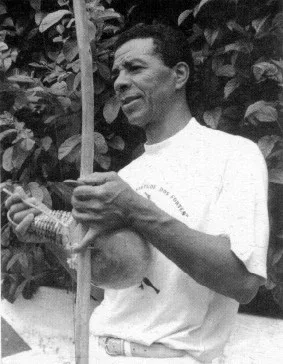
The Berimbau (a kind of jews harp) can be divided into two types: The Berimbau de boca, and the Berimbau de barriga. The Berimbau de boca was used by the old Angolians, hence, it used to be said that it came originally from Angola. This, however, is contested by some students of the subject. It consists of a bow that tightens a cord of "limbo" (a kind of vine). The resonating chamber is the mouth of the player. The cord is made to vibrate by striking it with a knife.
The Berimbau de barriga is the most usual type. It is formed by a piece of wood called "the pigeon" which maintains tension in a steel wire. The resonator is a small gourd attached to the wire by a string. The wire produces a sound which is modulated by a copper coin, while the mouth of the gourd is placed at varying distances from the abdomen of the player.
|
|
| As his opponent drops to the floor to avoid his attack, Capoeira master Vincente Ferreira Pastinha of Brazil aims kick. Stylized maneuver is dance-like in its execution. |
The Berimbau has many quivering vibrations which are marvelously adapted to the reproduction in sound of the swaying of hips and the feline jumping of the Capoeiristas. Independently of this, it lends a melancholy note to the singing of "Lundus" which accompany the movements of the game of Capoeira.
According to Oneyda Alvarenga, the music of the Berimbau is a "force activating the energies of two combatants, and in such manner the music ties itself to the game so that the latter is entirely dependent upon it, and is regulated by it." So, the ardor of the battle grows in accordance with the crescendo or ralentando of the music.
The other instrument which accompanied the evolution of the Capoeira is the caxixi. It consists of a round bamboo basket with dried seeds inside. The orifice is covered with dried gourd skin. It acts as an accompaniment to the Berimbau. Each time the wire resounds, it is accompanied by the rattle of the dried seeds.
The third instrument which frequently accompanies the game of Capoeira is the "recoreco." It is a large segment of bamboo, in which have been made innumerable lateral incisions for the escape of the air, which is caused to vibrate by a piece of cane which is scraped across the incisions in the side of the bamboo, thus producing the characteristic sounds.
Finally, we must consider the Pandeiro. It is a regional instrument, used not only to accompany the Capoeira, but also to mark the shaking rhythm of our sambas. Its shape is well known—the circle of quince wood, the goatskin top, and the jingles of Flemish tin. Certain societies of Capoeira use agogó.
TUNES OF THE BERIMBAU
The Berimbau is used by the accompanists of the Capoeira to produce definite and resolute tunes which modulate the rhythms of the game. The most important are the following:
| Sao Bento Grande |
– the light game |
| Sao Bento Pequeno |
– Samba of the Capoeira |
| Banquela |
– The Knife Game – lively, animated |
| Santa Maria |
– The Measured Game |
| Ave Maria |
– The Capoeira Hymn |
| Amazonas |
– The Middle Game |
| Iuna |
– The Creeping Game |
| Cavalaria |
– A signal denouncing the proximity of strangers |
Angolinha
Samba de Angola |
In view of what we tell, it is easy to understand the character of the game of Capoeira. At the sound of the music of Sao Bento Pequeno the combat is transfigured into the clashing of the Samba.
The good masters of Capoeira, in order to give a demonstration of singular ability in this game, after blows and counterblows, much whirling in the space left by the tangle of arms and legs, end the battle without showing a single spot or stain on their Sunday clothes.
The old masters, such as I, are capable of similar feats. At my age, 74, I also perform with my pupils. I would like to give exhibitions in any part of the world.
As a Brazilian, I am proud of this friendly country, which may wish to give me an opportunity to exhibit myself and my pupils there, in order to show our American brothers the possibilities of a personal defense against an enemy- An adversary or several adversaries, without the necessity of using firearms or knives.
|
|
| From his defensive position, the 74-year old Master Pastinha counterattacks. |
On the contrary, the Capoeirista, meeting his adversary armed with a weapon, has the possibility by means of the lightness and quickness of Capoeira, to disarm his opponent by taking his weapon from him; or, if it is not possible to take the weapon, to vanquish him by tripping and throwing the armed adversary to the ground.
Even though the Capoeirista may be physically inferior to his opponent, a good Capoeirista has no fear of him, be he of superior physique; be he a younger man, or be he armed tooth and nail.
In case it may not be possible for me to demonstrate Capoeira in America, I shall be proud if your people may have an opportunity to come to our land of Brazil—to live at Salvador-Bahia—to know intimately this game, this personal defense, which is the Capoeira, substituting well for any weapon physical force, or age, for self-defense.
Cortesia: Piter Bedoian
Vale ressaltar a importância, mesmo que a matéria esteja em ingles deste documento histórico que contempla fotos de Mestre pastinha com 74 anos.
|